

The Netherlands Ministry of Defence and Airbus join forces for optical communication at sea
New laser terminal to provide naval vessels with fast and secure satellite connection
Rotterdam, 19 November 2026 – The Netherlands Ministry of Defence and Airbus have signed a contract for the development and demonstration of the Maritime Laser Communication Terminal (MLCT). Using this innovative technology, in the coming years naval vessels will benefit from fast and secure optical communication links between ships and satellites. The first demonstration is planned for 2028. The project is being carried out in collaboration with the Royal Netherlands Navy, the Netherlands Space Command, and the Command Materiel and IT (COMMIT).
The MLCT project will establish highly reliable laser-based data links between naval vessels and Low Earth Orbit (LEO) satellites. Laser communication offers higher data rates than conventional radio frequency links and is immune to electronic detection and jamming by adversaries. The terminal is designed to remain operational under variable weather and sea conditions, delivering stable, secure connectivity at sea that is of strategic importance during modern military operations.
“With this contract, we are taking a tangible step towards making laser satellite communications operationally viable at sea,” says Rob Postma, Managing Director of Airbus Netherlands. “It reinforces the Netherlands’ technological lead in this field and illustrates how targeted defence procurement and private co-funding work together to drive innovation and high-value local employment.”
Derk Boswijk, State Secretary for Defence: “By keeping the development of the Maritime Laser Communication Terminal entirely in the Netherlands, we are proving that targeted defence procurement both accelerates innovation and strengthens our industrial capacity. This sovereign technological development is crucial: in a world where digital connections are a strategic weapon, we must take the lead ourselves in delivering reliable, secure connectivity for our fleet.”
The Maritime Laser Communication Terminal is engineered in the Netherlands. The Airbus team in the Netherlands leads a consortium consisting of TNO (the Netherlands Organisation for Applied Scientific Research), FSO Instruments, Nedinsco, and Celestia STS. By keeping the technology within the local ecosystem, the Netherlands is securing sovereign technological expertise and industrial manufacturing capacity. Following a successful demonstration, the terminal will be able to deliver global connectivity for the Dutch fleet and pave the way for interoperability and cooperation with NATO allies.
The project, in order of the Netherlands Ministry of Defence, is supported by the Commissariat for Military Production (CMP). Additionally, investments of both Airbus Netherlands B.V. and Airbus Helicopters contribute to the project. For Airbus Helicopters, the maritime terminal provides valuable technology building blocks for potential future applications on helicopters and uncrewed aerial vehicles, where weight, vibration, and secure communications present comparable challenges.
Through the development of the Maritime Laser Communication Terminal within the Dutch ecosystem, combined with Airbus’ experience in industrialising such technologies, the Ministry of Defence is helping build a robust European industrial capability for mobile optical terminals. In doing so, the Netherlands is laying the foundation for the next generation of maritime satellite communications: faster, more secure, and sovereign.
#SpaceMatters #Airbus #AirbusHelicopters
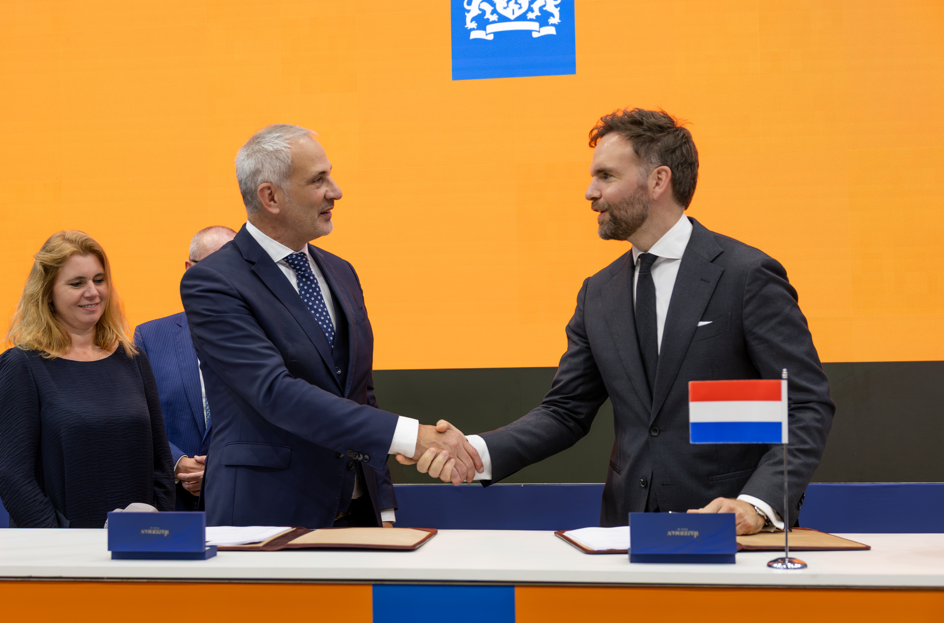
From left to right (background): Julie Tessier, Head of International Cooperation and Offsets at Airbus Helicopters, and Jan Christiaan Dicke, Commissioner Military Production at the Ministry of Economic Affairs. Foreground: Rob Postma, President and Managing Director of Airbus Netherlands (left), shakes hands with Derk Boswijk, State Secretary for Defence of the Netherlands (right).
Share